Learn more about Against the Grain: The Farm Aid Podcast
 Against the Grain brings the magic of Farm Aid’s annual festival to listeners year-round. Hear from farmers and artists, advocates and food experts, activists and policymakers – all of whom are working towards building a more just and equitable farm and food system.
Click here to listen!
Against the Grain brings the magic of Farm Aid’s annual festival to listeners year-round. Hear from farmers and artists, advocates and food experts, activists and policymakers – all of whom are working towards building a more just and equitable farm and food system.
Click here to listen! Listen to the episode below. And, make sure to subscribe in your podcast app of choice!
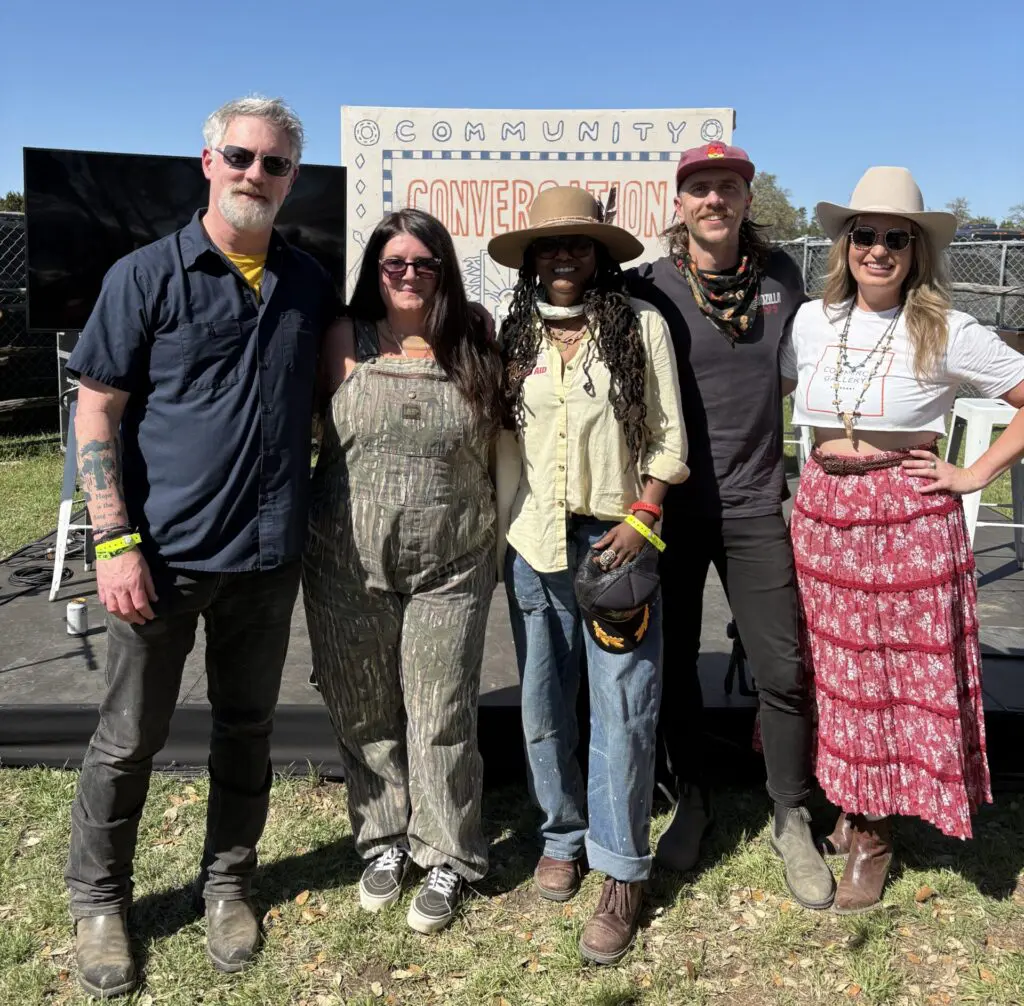

Jazz Mills
Jazz Mills is an Austin-based, singer-songwriter perhaps best known as a member of Cowboy and Indian, as well as an artist manager and community organizer. Jazz is the founder of Free Lunch, an Austin-based collective of five creatives dedicated to providing meals to the community in need. With a focus on offering nuanced support tailored to the unique needs of each individual, Free Lunch partners with Our Shared Kitchen and Walking By Faith to deliver three meals a day, seven days a week, 365 days a year to the Esperanza Community, a state-sanctioned 7-acre encampment of the unhoused in Southeast Austin. Free Lunch is sustained through community support, primarily from subscribers to their magazine whose contributions ensure the consistency and longevity of the program.
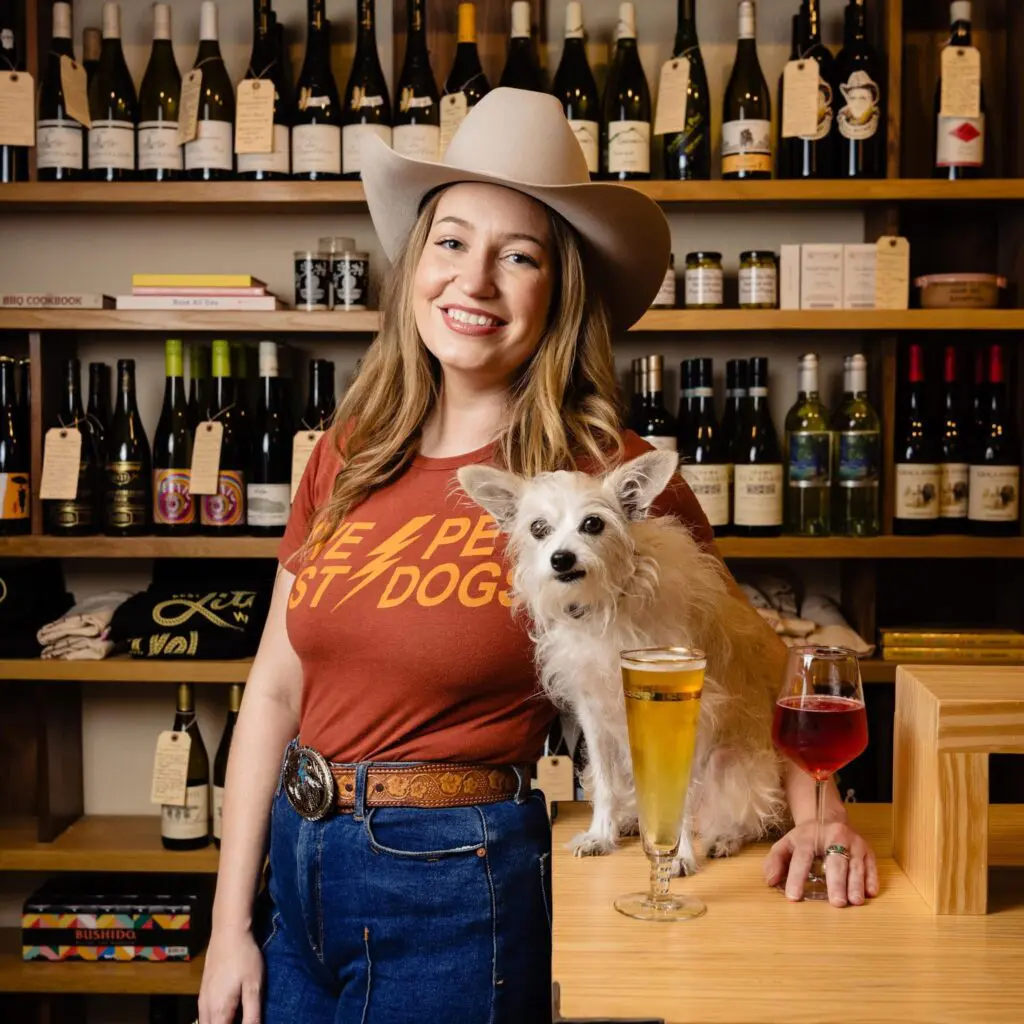
Kaye Askins
Kaye Askins, a 15-year hospitality veteran, is the owner/operator of Best Little Wine & Books in Lockhardt, Texas. She was awarded Wine Spectator’s “Best Award of Excellence” in 2020 and has certifications from the Court of Master Sommeliers, WSET Global and is a certified Italian Wine Professional. Kaye is the founder of the Texas Hospitality Collective, an organization that mobilizes Texas hospitality professionals to nourish communities in crisis and advocate for lasting change. Kaye organized the Collective in response to the catastrophic July 2025 flash floods that took the lives of more than 130 people. The Collective mobilized more than 30 chefs and 900 volunteers to deliver 11,000 hot meals and emergency supplies from a field kitchen set up at the Quiet Valley Ranch.
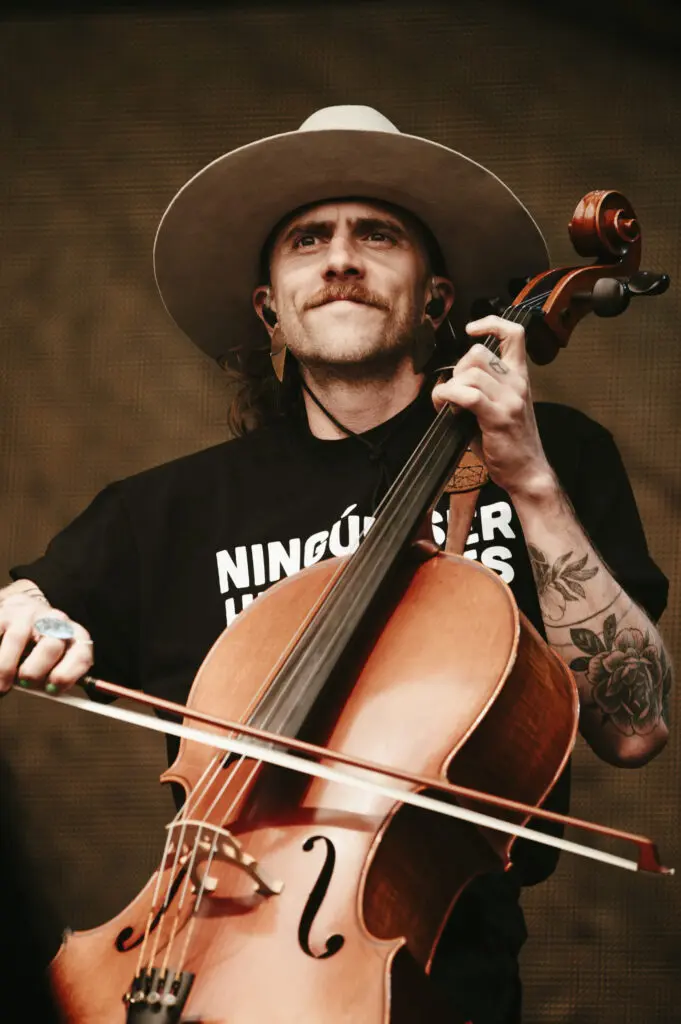
Photo: Brian Bruner
Eamonn McLain
Eamonn McLain is the cellist in the Duluth, Minnesota-based band, Trampled by Turtles. The band was formed by frontman Dave Simonett as a side project in 2003, and the group quickly began carving out a fast, frenetic sound that owed as much to rock & roll as bluegrass. Eamonn started sitting in with TBT in 2012 and became a full-time member of the band in 2014. He lives in Minneapolis, where he is deeply involved in his community, including showing up for his neighbors in South Minneapolis in the face of ICE’s Operation Metro Surge earlier this year. You can check out Trampled by Turtles playing Farm Aid 40 in Minneapolis here.
KURN [00:00:06] Welcome to Against the Grain, the Farm Aid podcast. I’m Jessica Ilyse Kurn,
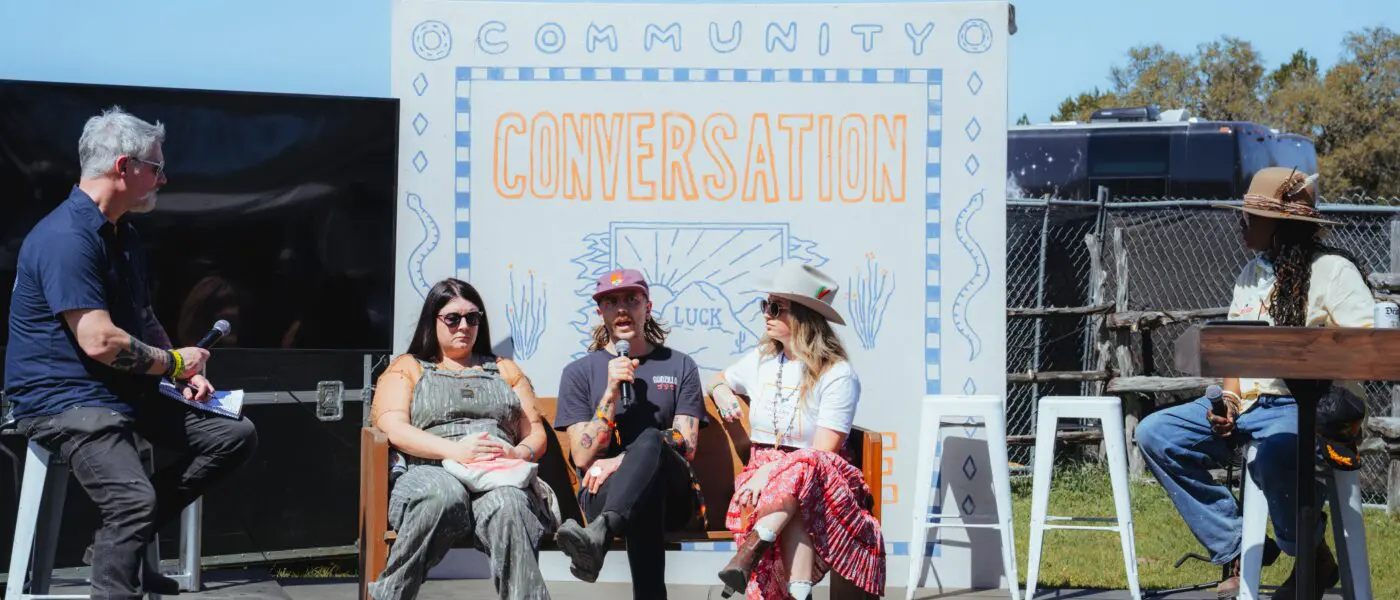
FOLEY [00:00:11] and I’m Michael Stewart Foley. Today we’re bringing you a panel discussion that was recorded live at this year’s Luck Reunion.
KURN [00:00:18] Luck Reunion is a festival held on Willie Nelson’s ranch outside of Austin, Texas, and I always love going to Luck, but sadly this year I wasn’t able to join the Farm Aid crew. But Michael, it sounds like you had a great time.
FOLEY [00:00:31] Yeah, it was pretty great as usual. The vibe was kind of amazing. We had the potluck dinner and the festival the next day, with all kinds of amazing bands performing, and Willie closing out the night, both nights. And our friends at Luck are pretty incredible. They gave us a lot of space to work with this year, so we built out a whole exhibit on Farm Aid II, which had its 40th anniversary this year. And we also had a farm stand, so we’re providing fruit to festivalgoers throughout the day, that was wildly successful. We got to meet and talk to a lot of really great people.
KURN [00:01:04] Um, darn, I truly missed a good time, but there’s next year, and I’ll be there. I also wasn’t able to host a panel discussion with you like last year, but thankfully, Farm Aid’s co-executive director Shorlette Ammons was on hand to tackle this one with you.
FOLEY [00:01:20] Yeah, and that was pretty great. Shorlette fit right in. We do this kind of thing pretty often, and so she brought some energy and vibe to the whole conversation. The panelists we invited were all folks who showed up for their neighbors in the face of one or another crisis. We had Jazz Mills, the director of operations and co-founder of Free Lunch, an Austin, Texas-based organization dedicated to providing meals to people experiencing homelessness. Eamonn McLain, who’s the cellist in the band Trampled by Turtles, who played at Farm Aid 40 last year, and who worked in Minneapolis during Operation Metro Surge, and Kaye Askins, a community organizer based in Lockhart, Texas. She’s the co-founder of the Texas Hospitality Collective, which is a nonprofit that mobilizes food and beverage professionals to provide disaster relief and hot meals to affected communities, basically in the midst of disaster management.
KURN [00:02:14] Yeah, I was impressed listening to each of them talk so passionately about the solidarity that comes from working with neighbors and the strength they got from watching out for their communities.
FOLEY [00:02:23] Yeah, one thing that’s worth pointing out before we roll the panel is the discussion of Operation Metro Surge, which I mentioned when I was introducing Eamonn McLain from Trampled by Turtles. In case you don’t know that reference, it’s from earlier this year, when masked ICE officials terrorized the Twin Cities in Minnesota. And rounded up people indiscriminately, leaving two American citizens murdered in the streets. They later expanded into the entire state.
KURN [00:02:50] Yeah, and I remember that the Associated Press reported that the Department of Homeland Security was proud to call Operation Metro Surge the largest immigration enforcement operation ever carried out. All of our panelists modeled how to take action in response to tragedy and challenges within their communities. They saw a problem and they figured out a solution.
FOLEY [00:03:12] Agreed. We had a really great group representing that Farm Aid ethos that Willie started 40 years ago of really walking the walk, not waiting on others to step in and help. We could have talked for hours. But for now, I started the panel by asking each guest to explain their impulse to start working within their communities. Here’s Kaye Askins to start.
ASKINS [00:03:42] I remember the exact moment of. You know, hearing about the floods. And what’s crazy about it is as big of a state as Texas is, all of us really are neighbors. It’s such a small world. There are so many people who are linked together, and you don’t realize it until really like you get into something pretty major like that. There was a group of us that went out to Martindale for the 4th of July, and we knew it was raining and we were a little bit inconvenienced, you know, trying to get out there and park and walk in the rain.
We’re like, we’re going to watch the parade, no matter what happens. And, you know, you start getting all of These messages, you know, about major flooding and possible casualties and what, what else. Every single day, it seems like there really is something. So most people, I think at this point, just turn off their notifications. You can’t tackle it all. And as the news just kept getting worse, it was really just an, an instinctual, like, It, it was just really breathtaking, you know, we’re all sitting here, we’re celebrating the 4th of July. We’re river people.
I go out and fish on the gud every single week. And I, I took a step back. And thought, You know, there are 100s of people who don’t know where their family members are right now. And what do you do? So it was like that day of the 4th of July, we just kind of sat and sulked about it, like, what do we do? I just wish I could get out there. Like my heart hurts so bad for them. And then we were out there every day for the next month, basically.
FOLEY [00:05:28] Amazing, amazing. Thank you. Uh, Eamonn.
MCLAIN [00:05:32] I guess for me, there was, there was the, the metro surge that started and the Trample guys pretty shortly after it started decided that we could definitely like take proceeds from merch sales because we’re on the road and we’re doing stuff and we can just pump that into organizations that are, that are supporting immigrants in, in Minnesota, um. Meanwhile, when I was, when I got to be home, and I was doing some things that were out in the community, we had some really great protests and it’s really important for people to show up to protest. Um, Minnesota is pretty awesome, the turnout that we, that we ended up doing, I mean it was like, so it was, we had, we had days that it was -15 and people came out and we had days that it was 32 and raining and people came out, which is not fun to be protesting in, um, but it’s really important for people to show up. Um, and, and the craziest thing about it is that you do, you feel, you feel insane, you feel overwhelmed, you feel powerless to do anything, and you’re like, well, why even bother? And then as soon as you do take one little step, you, you feel so much better and you realize that the, the next step is easier to take and you’ve, uh, you meet more people and it’s the people that you meet that then, oh, I can plug in here or whatever, um, and, and it just starts to build from there. But then we were out of town and one of my friends, they got some new tactics put on them by ICE where they were, they were following vehicles and they were filming and they got marked or docked by ICE and then ICE did a thing where they got two vehicles on either side and then they reversed and, and sped forward and then crashed their car and then they blamed them for causing a, a vehicle accident and um And then arrested both of them and it’s on film and it’s like this, this small femme being thrown to the ground, um, and so that was kind of a little bit of a turning point where I was like we can, you know, we can, we can step this up, we can do more than just proceeds from, from merch sales, we should do a benefit show which Um, again, it’s just sort of in, in your lane, like definitely spread out and try new things, but like, OK, where do we have the most impact and the, the, the spot that we decided was we can generate money and we can put that in organizations that are, that are, you know, doing the, the, the work on the ground.
And so we quickly threw together a show. We have friends with First Avenue, which is a, a big music venue in Minneapolis who also has multiple venues including the Turf Club, which is ultimately where we ended up playing, and it’s sold out in minutes. My friends couldn’t even get tickets. They were on the waiting list and it was just instantly, and, and I think the. The beautiful thing is, that if you create environments where people can show up and they can put their dollars and they can feel like they’re contributing, people want to contribute. The only way to combat it is to, to build community, get a whistle, you know, it’s like, it’s really funny that it’s like, oh yeah, they have guns, but we have whistles, and it, and it turns out you film these guys and they don’t, they don’t want this to, to be the way that they’re remembered, and we don’t want them to forget that they’re doing what they’re doing.
FOLEY [00:08:42] Thank you.
MILLS [00:08:44] I think that like when you ask like what is the moment that you felt like you could do or should do something or ready to do it, and for me it was like pretty rage-based and kind of ego-based too, honestly, like, I had realized for a long time that I was like, what the fuck is this? Like, I don’t want to talk about this anymore. I don’t want to. Uh, this can’t be this hard. Like there’s just a person right there that like needs food. It can’t be that hard to give it to him.
Like there’s food everywhere. There’s like grocery stores that have too much food. There are organizations in Austin that literally exist to repurpose waste. Like this is starting to really piss me off. Like, how can we have food waste and hungry people at the same time? Like, and it was making me so mad. And then my ego sort of kicked in and was like, what are you doing? You’re just mad. You’ve just been talking about it too, like you are what you hate. And then I got super embarrassed and then was like, OK. I really don’t think it’s that hard, and I don’t think that everybody has the disposition to serve the unhoused. Like it’s a very specific type of job. You have to be pretty thick skinned and like, You do have to be a people person to do it. And I don’t think that that task is for everybody, but I do think there is something that everybody can do, and only they know what they can do.
So, a lot of what we talk about at Free Lunch, like outside of our actual meal program, when we talk to different companies or we have volunteers come in, is really just about like, ask yourself, like, do I care? Do, like, What am I capable of doing? Am I willing to do it? How consistent am I willing to be? And like, if you can answer those questions for yourself, you’re like way ahead of the majority of people who do care. Like in theory, everybody, most people who are not psychopaths care. They’re like, well, I don’t want people to have basic needs. I’m like, unfortunately, that’s not enough, like, We all care, you know, but like it’s going to mean we have to put 1 ft in front of the other. There is no shortcut to that. There is no program that can come in and substitute us putting 1 ft in front of the other, looking at someone in the eye, figuring out their name, building a rapport. What are the specific needs that you need? I mean, that’s why we’re here.
AMMONS [00:11:08] So that calling, if you will, we were talking about that in the previous panel, like to really check yourself and ask yourself the question, what is in my power to do? So I think people ask themselves that question all the time. If you live in a position where a lot of these, particularly brown folks in Minneapolis were, The fear was too big for them to do what they were, what they knew that they deserved, or they, or even to have the life that they knew that they were owed, that this country owed them, but it then took somebody who didn’t look like them and yourself and recognizing, oh shit, I have a platform, and I believe artists can tell the truth. I believe music tells the truth. I believe that music can share the story of grief, but also can share the story and initiate overcome. So as artists, could you just talk about that role from where you’re positioned as people who create stuff, beautiful things, complex things, mindful things, things that make us all ponder our positionality like you were talking about, um, and, and was there, is there an artist in your world, you know, past, present, future, who is who that Willie has been for Farm Aid. So I’m, I’m looking at you dead and I.
MCLAIN [00:12:23] Well, it’s interesting. I feel like I need to do better at reaching across and like meeting people that have different beliefs in me and trying to come to come some common ground because he does a great job of being like this is a great country and fuck it is a great country, but we’re not doing great right now and we’re not gonna get better if we’re not, if we’re not, you know, unifying each other or with each other and, and um it is, it is about community building I think is the most important thing and, and, um. The band that I’m in is maybe not Rage Against the Machine, you know, like we’re, we’re not screaming maybe the views that some of us at least have in the band all the time. But what we, what we are looking at is the human experience and we all need to be able to have the best that we’re owed, you know, like, like we, we lucked out, we were born in this country or we’re in this. Country now either way, um, or maybe we’re not, maybe we just get to hear things about this country and be like it’s still a good place. It’s small things. I mean like this, especially with the crisis that we we have in my state, it’s no longer a political issue, it’s an, it’s a human issue.
MILLS [00:13:34] Um, yeah, I think like being an artist is actually like an enormous part of like our business model at Free Lunch because when I first started, people don’t expect me when someone’s like, oh, we’re going to meet with the founder and CEO of Free Lunch like that’s not what they’re thinking when I walk in and like. And I would say that I’m wildly underestimated most times, and I’ve learned how to use that to my advantage, but everybody told me that what I was trying to do wasn’t going to work. They’re like, Oh, it’s like really unrealistic, but like adorable, you know, and it’s such a pleasure to be able to show up for people in need that way, you know, and like I think being an artist is what made me be like, I’m going to do whatever I want. Like that’s the realm I come from. That is the whole point of being an artist is that, and if someone tells me that I shouldn’t. It’s on now, you know, I’m like, I’m doing it.
And so like I think that it was a huge, huge influential part of being, of being in like community service work is coming from that mindset of like, this is how things used to be done, that means absolutely nothing to me. I’m gonna do, I’m moving this direction.
AMMONS [00:14:41] So you can be adorable and badass at the same time. That’s the moral of that story, friends.
ASKINS [00:14:47] I come from a little geekier background of artistry. I spent an equal amount of time as a classically trained musician, um, classical and jazz. Anybody that knows me on a personal level, it’s pretty obvious the way that I lean. I’m very outspoken about things, and I contribute to causes that I’m firmly, you know, I firmly believe in and, um, and invested in. But there’s also something really nice about being able to use music, if we’re talking about music specifically, um, and hospitality to just strip everything off of the table and Once you get to a stage, once you get to a table, especially when there’s, there are no lyrics, you are just invoked by where the music is taking you. Similarly with hospitality, when you’re sitting at a table and you’re sharing food with people, you know, there’s scientific studies about, you know, what your brain does. It gives you this reward. When you get to pass a dish on to someone else or if you’re like, hey, here, take, take a, take a sip of putting your lips on this. I’m putting my lips on this. Like that’s a really close connection without really having to say anything at all. Um, so I think in the realm of, of what all of us do, even if you aren’t running a nonprofit. Uh, maybe you volunteer, maybe you’ve never volunteered before and, and you’re just trying to figure it out. I would say, you know, one of the most important things is perhaps not even to like be concerned with, um, political alignment, but figure out a way to just get out there with no qualms about. What you’re doing just for the sake of showing kindness and hospitality to the person sitting next to you.
AMMONS [00:16:42] Love that, love that.
FOLEY [00:16:44] Amazing. Um, I was thinking as you were talking, all of you talking about like rage and what motivated you, there used to be like a pretty common bumper sticker that was like, if you’re not outraged, you’re not paying attention, they should maybe bring that back. I haven’t seen it in a while, but um. That feels important, like listening to your rage, not being hard-hearted and thinking like I can’t do it. But it strikes me as we’re talking about this, and particularly as you’re talking about this from like an artistic perspective, people might get the idea that, like you’re obvious in the kind of work that you do, but you’re also like normal people, right? And maybe you could talk a little bit about that, like for people who might be thinking about wanting to take a step and not feeling like they could do all the stuff that y’all do because it seems so amazing, you know. And maybe talk a little bit about the challenges, like what have been the most challenging things you’ve faced in trying to get these things off the ground or keep them going.
AMMONS [00:17:42] Uh, they’re giving abnormal to me. I’ll be honest. They’re, they’re not giving normal at all, but go ahead, Jazz.
MILLS [00:17:50] I think that like for me, our job is actually really unskilled labor. Like it’s literally anyone can do it. I’ve like taught. Like four or five year old classes, how to do what we’re doing. Um, I think that’s the point of what I, that’s the root of where I wanna get to with community services like we’re really overthinking this, like, you know. A lot of people, the reason why they don’t stay consistently in community service is because they overthink it and they do something really big and really grand that makes them feel really good, but it was really hard and they’re not going to be able to do it again until Christmas next year. And like everybody helps on Christmas, so what ends up happening is the people are like, I’m not hungry and like I don’t need that or I already got a blanket today and I’m like, we need people in February when it freezes. We need people in March when people lose their blanket like. We need people all the time. So for me, it’s not about Like we are regular people. Like I was just like, and I was in a shitty time in my life when I started free lunch and was like super stressed out as a single parent and like didn’t know what I was going to do. Like who’s, who the hell is going to pay for my daughter’s glasses, you know, like. I didn’t become like a better version of myself, and then I got involved.
I just was like, it really can’t be this hard and like it, that is what made me feel better was being like, I think I can do something, and then I did it and I was like, this is extremely reciprocal. Like I can’t believe how easy that was. That made me feel crazy powerful. And I do think that’s a part of this, that is a part of. The relationship that it’s OK to nurture. If you see someone that is struggling, just help them and if you’re like, I can’t, it makes me feel uncomfortable, find somebody else who will they’re out there, you know, like that, and I think that you’re gonna just have to decide to do it and like the hardest part about free lunch is there isn’t anybody holding me accountable, you know, like if I, if we decided we didn’t want to do it anymore, there, the people. We serve would be like, oh man, but the rest of the world will go on, you know, so like the hardest part of the job is being like, I have to be consistent every day and I’m making that commitment to myself and to my work, and there isn’t anybody here to babysit me.
But, you know, through this, I just have to be that committed to what I’m doing and like I do think ego is an important part of it. You can use your ego to your advantage where like, I don’t want to wake up 25 years later and be embarrassed of myself, you know, I want to wake up 25 years from now and be like, man, I hustled, like I did as much as I could, you know, and so my little future Gemini witchy self is like, don’t fuck this up for us, you know,
AMMONS [00:20:32] Yeah, you’re blowing every cliche out the water today. Rethink everything. No, that’s it. It’s like stop. Let’s let’s stop with the, because it’s, it’s on that similar line as thoughts and prayers, like the things that we tell ourselves.
What if we question those things, you know, like I have to be a better version of myself in order to da da da da. You just really just blew that out of the water.
MCLAIN [00:20:53] I think like you like you’re saying you’re worried about the future and, and like, oh fuck I did I, did I screw all this up like when I had the chance, but I think people are just as afraid to take the first step as they are to look back at the past and what they did or didn’t do and, and, and just, just. Doing anything like, like, oh, I don’t wanna go out, I don’t wanna meet new people, whatever, fine, then call your politicians. I had no idea how easy it was and it turns out you can take one minute and you can do that and yes, their policies are gonna take too long and they are not gonna help us right now, but if we start now, then in five years maybe something will happen in 10 years, maybe something will be different and, and. And that doesn’t feel great. So maybe find something else to do also, but like, at least you’re doing something when you, when we’re doing that stuff.
AMMONS [00:21:40] We call that the walk and chew gum at the same time strategy. I mean, this is professionally. I’m, I’m strictly professional. No, we can do multiple things. We’re, we’re dynamic human beings and, and the point of your community building conversation, it’s good to have a homie that’s doing the other thing while you’re doing the other thing. So you want to tie into that?
ASKINS [00:22:01] We had an instance during flood relief where we really did not know what we were getting ourselves into. We didn’t plan. We’re just a group of friends that were saying yes to all of our other friends, like, yeah, we’ll be there. Yeah, let’s do it. Who do you know? And before you know it, it’s like, blank, oh my God, we’re in a group chat of 30 people.
What is going on? Who are you? You know, like, it’s a bunch of phone numbers and yeah, we’re just doing what we can. And, you know, Matt Beizer here with, with Luck Reunion. Um, he took our volunteer form that we just threw together. We schlapped that thing together as quickly as we could and put it out there, and then things exploded to the umpteenth degree, and there are people in the crowd right now that were out there doing it with us every day, starting at basically day two, and you can’t answer everybody. That’s OK, like. You know, we’re not an actual organization. We’re doing what we can to feed first responders and do other things. And, you know, there were times where, like the volunteers that we called back, you know, I say, hey, here’s, here’s where you go, here’s where you park, um, check in with me. Here’s probably where I’ll be. But if I disappear, just find somebody. It’s not a big place where we were at that time. And for the most part, people totally got it.
But then there were enough people who had a very different idea of what it was going to be like, who thought, um, or expected, OK, we’re going to stand out on the side of the road and we’re going to pass out cookies and Gatorade to the fire department. And it wasn’t that at all. It was actually very traumatizing. I mean, it was a historical, just mass grave that we were looking at. So you’re also having to kind of educate people on emotional intelligence. Hey, if you’re going to be driving food into the flood zone. You got to keep it cool.
Don’t put any of your own emotion onto these people. Hand them everything that they need. Ask them if there’s anything else we can do for them. Hey, there’s no running water, there’s no electricity, there’s no ice, there’s nothing for these people. If you can get an extra contact, cool, and then you come back, you don’t need to stand and chat with them, you know.
AMMONS [00:24:21] I don’t want to miss the call to action. I mean, how, how do we light a fire up under each other, you know, whether, I mean, I hear the range, um, from ego and performance to don’t get in the way of a good thing, you know, get in where you fit in kind of vibe. Um, it’s kind of like double dutch, you know. So, um,
FOLEY [00:24:45] I thought you were going to call to action.
AMMONS [00:24:46] I was gonna do that, but you were looking at me like
FOLEY [00:24:48] I’m following.
MCLAIN [00:24:48] I, I can actually say something to that too.
AMMONS [00:24:50] Yeah, please do.
MCLAIN [00:24:51] Find something local. Like, like, we, we’re all in different communities here, and if, if you’re feeling overwhelmed, go more local. Do you, do you like. Do you know everyone on your block? Is everyone on your block doing good?
Is everyone in your neighborhood doing good? Like, if you’re feeling like something is too big or if you can’t feed your entire neighborhood or something, if that, if that feels like you don’t know where the first step is, look closer to home. You might be amazed that you’re doing better than someone that you thought was doing better than you. And so I think, I think just keeping, keeping things close to, close to home is, is a really great place to start. And if we can have really solid foundation, then we can start expanding the different movements and, and we can start making real change.
AMMONS [00:25:39] Check on your people, check on your neighbors. In the South, we call that visiting. Just go visiting sometimes, right on. Thank you for that. Either one of you, we’re call to action mode.
MILLS [00:25:50] Um, I think that try to keep it fun because like, you know, everything sucks and everyone’s pissed and like at their wits end and so I feel like trying to be like. You know, hey, we’re going to have a party at my house and everybody brings something to share and bring enough for there to be leftovers and then we’re all going to package it up together and we’re going to take all this food to a place and like, and then we’ll party again like, and I think it’s important for people to recognize that I’m like, You know, free lunch is making a ton of food a year now, and we all work part time. We’re all still musicians. I manage bands like we have time. It isn’t as hard as you’re saying it is. Like if me and my friends are doing it and we’ve been doing it for 6 years, then you can do it.
And a lot of people that I run into, what they really need more than anybody is for someone to pay attention to them for just a second. And like as soon as I sit down with him and we talk about, oh, we’re both mothers or we’re musicians or we like overalls or whatever we’re talking about, it doesn’t take very long for me to watch people kind of thaw out, you know, and like I’ve been on the receiving end many, many times of someone saying, I’ve never said this before or I can’t believe I’m telling you. This and I’m like I can because I bet I’m the only person that stopped and like stood here today and asked you all these questions and that’s all it took. So yeah, I think what he’s saying is true. Don’t think globally, just think about what’s in front of you and take small like I wanna be a superhero, but I know that there’s like a lot of steps I got to take. You know, to get there, and free lunch has made me feel that way. It has definitely reinforced my superhero complex and have fun, have fun
AMMONS [00:27:30] and have fun and have fun. Thank you.
ASKINS [00:27:36] Yes to all of those things. Um, I’m a very social person and, and so, um, paying attention to your neighbor and And a neighbor, I’m talking about that guy right across the street from me every single day, you know, what I, what do I see going on? And, you know, have we waved hi to each other today? Have I seen him in a while, that sort of thing. Um, I also get that that is just not in everyone’s personality. Um, so I would say for anyone sitting here today who’s like, You know, I want to get involved somewhere and I wanna start like first thing on Monday.
I would say, you know, look towards your local food bank just as such a simple starter. It can be really emotionally challenging, depending on what area you’re in. In Lockhart, we have the, the Caldwell County food pantry and as someone who, you know, I run my own business, I’m involved in a lot of things, the, the easiest way when I first moved there to get involved was through them. I’m like, hey, what, what can I do if it’s at least like a once a month program? And that’s, you know, the capacity I have at this moment. And you know they offer a once a month every first Thursday of the month stuffing backpacks for kids and I’m like, yeah, I can do that. It’s noon to one. Let’s go and um man, it’s the easiest thing in the world. You just show up and the more times that you do that you start to get to know you’ve got the same volunteers that are behind you and in front of you. So I would say like if you’re just. Mildly anti-social with your neighbors. We really can’t talk you into that. At least, at least look at your food bank, see what kind of programs they have. If it’s not stuffing backpacks, maybe, you know, it’s working in a community garden, but at least figuring out what those organizations are is a really good start.
AMMONS [00:29:50] Awesome. Thank y’all so much and thank our amazing panelists.
FOLEY [00:30:06] Thanks again to Kaye Askins, Jazz Mills, and Eamonn Mclain for agreeing to be on the panel and be such brilliant guests.
KURN [00:30:13] We’re listening to Eamonn Mclain performing “Wait So Long” with Trampled by Turtles from Farm Aid 40. Speaking of the festival, Farm Aid 2026 is coming up, and we hope you’ll join us on Saturday, September 26th, in beautiful Virginia Beach, Virginia.
FOLEY [00:30:29] That’s right. There’s still a few tickets available. You can learn more about that at FarmAid.org. It’s at the top of our webpage. And be sure to come find us. Say hello, Jessica and I will be there recording for the podcast. We’d love to get to meet you, talk to you, and we’ll have Against the Grain podcast buttons for everyone.
KURN [00:30:58] Is there something you want us to cover in the future? Send us an email or drop a comment. You can email us at podcast@farmaid.org and find us on social media, which is @Farmaid on Instagram, Facebook, Threads, and Blue Sky.
FOLEY [00:31:12] And don’t forget YouTube where you can watch almost 40 years of performances and other content. Let your friends know about Against the Grain too. We’re beyond grateful when you listen, share, like and subscribe to this podcast.
KURN [00:31:24] Against the Grain was written and produced by us with sound editing and direction from Dawn Sorokin, and thanks to Micah Nelson for our awesome theme music.
FOLEY [00:31:36] Head over to our website to learn more about the podcast, www.farmmaid.org/podcast. And thanks to all the farmers out there, we’ll chat with you next time.